Your Website Isn't Just for Google Anymore
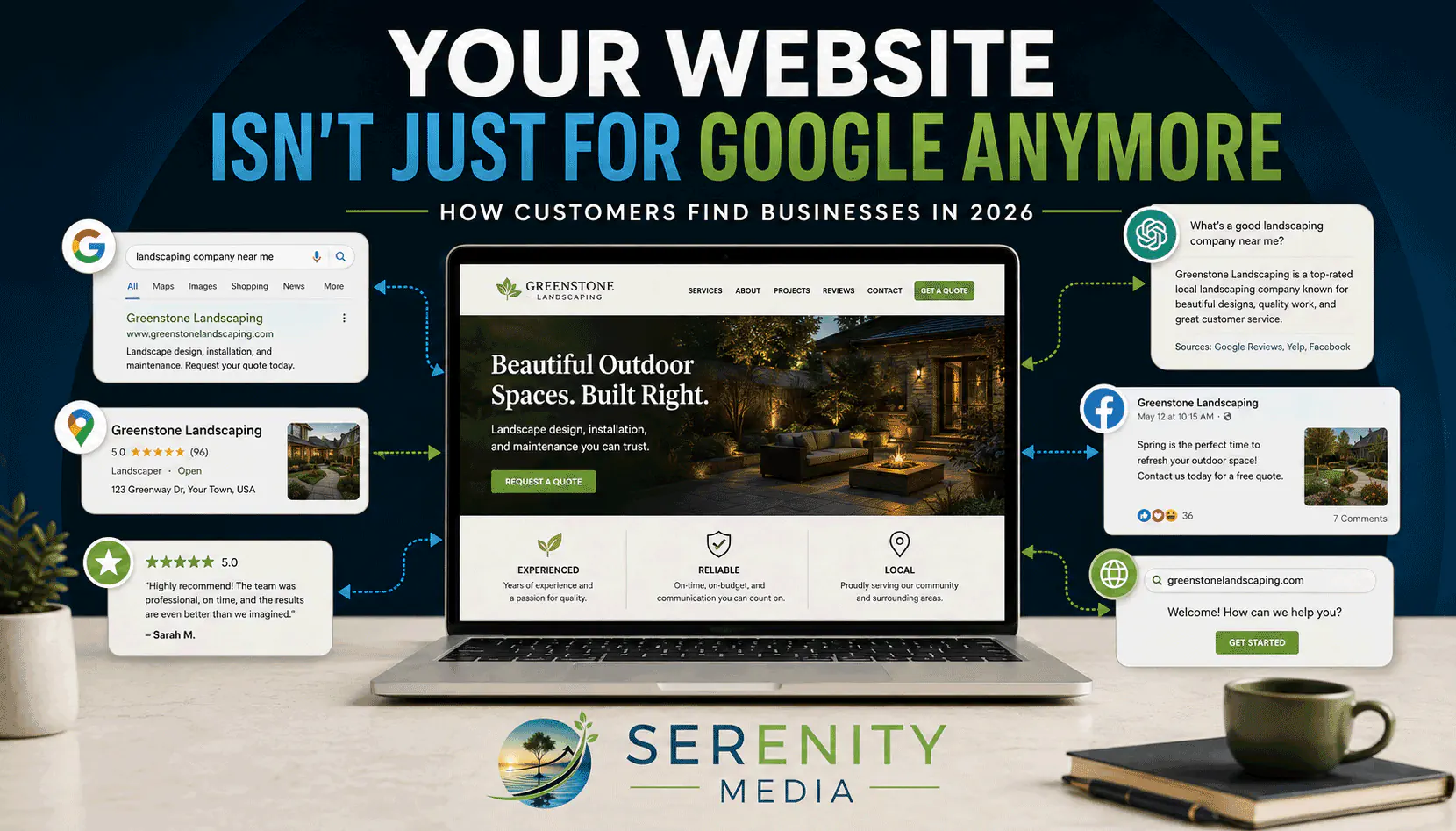
Customers can discover a business through Google Search, Maps, social media, reviews, AI answers, Reddit, referrals, or an ad. The real challenge is making sure every one of those paths leads back to a business that is easy to understand and easy to trust.
A few years ago, the basic digital-marketing goal was fairly simple: build a good website, optimize it for Google, and try to rank when someone searched for what you sell.
That still matters. A lot.
But it is no longer the only way people find businesses.
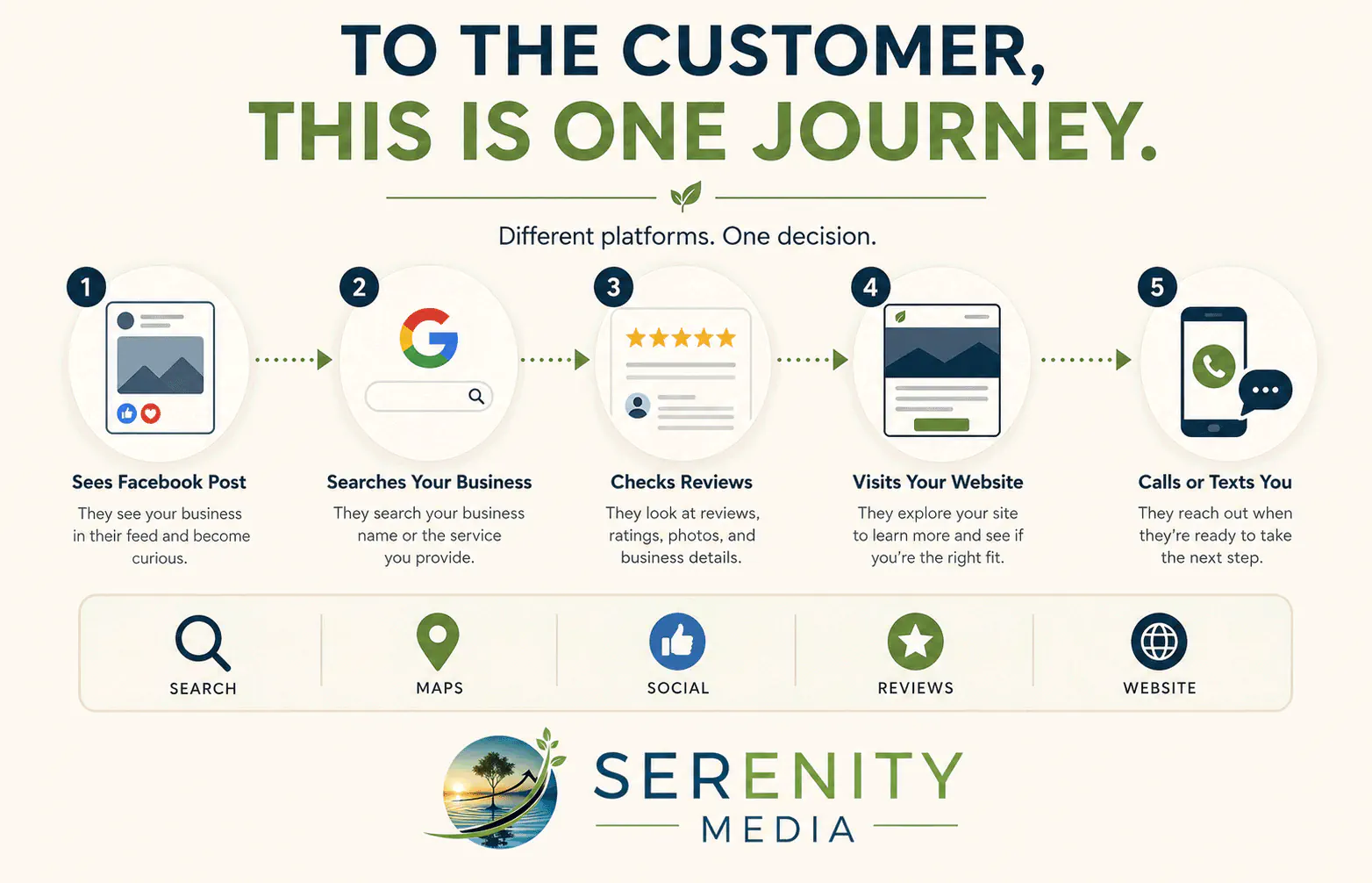
A potential customer might see your company on Facebook, search your name later, look at your Google Business Profile, read a few reviews, ask an AI tool for recommendations, click into one of your service pages, and then text you from their phone.
From the customer's point of view, that is one buying journey.
From a marketing point of view, it may have touched five completely different platforms.
Search Isn't Disappearing. It's Spreading Out.
People still search Google. But discovery now happens in more places and in more ways than a traditional list of blue links.
Your Website Should Be the Source of Truth
All of these new discovery paths make the website more important, not less important.
Your website is where you have the most control over explaining who you are, what you do, where you work, what makes your company different, and what someone should do next.
It is also one of the clearest places for search engines and emerging discovery tools to understand your business.
Be Specific About What You Do
A vague services page makes the customer work too hard. Dedicated pages for important services give people and search systems clearer information.
Be Clear About Where You Do It
Local businesses should make their actual service area easy to understand instead of forcing visitors to guess whether they are inside the territory.
Answer Real Customer Questions
Good content should remove uncertainty. It should answer the question a customer actually has before making a decision.
Make the Next Step Obvious
A visitor should not have to hunt for a quote form, phone number, text option, product page, appointment button, or other primary conversion action.
Your Google Business Profile Isn't Just a Map Listing
For many local businesses, the Google Business Profile is one of the first substantial interactions a customer has with the company.
They may see your rating, read reviews, look through photos, check your services, confirm your hours, click your website, or call you directly without ever starting on the homepage.
That means the Business Profile should not be treated as a box you filled out once three years ago. Accurate services, current photos, consistent business information, real reviews, and occasional updates all contribute to the picture a potential customer sees.
AEO Isn't a Replacement for SEO
Answer Engine Optimization, or AEO, is becoming a popular phrase as businesses try to understand how AI-powered search and answer tools fit into marketing.
The problem is that AEO is sometimes sold as if it is a secret new tactic completely separate from everything that came before it.
It isn't.
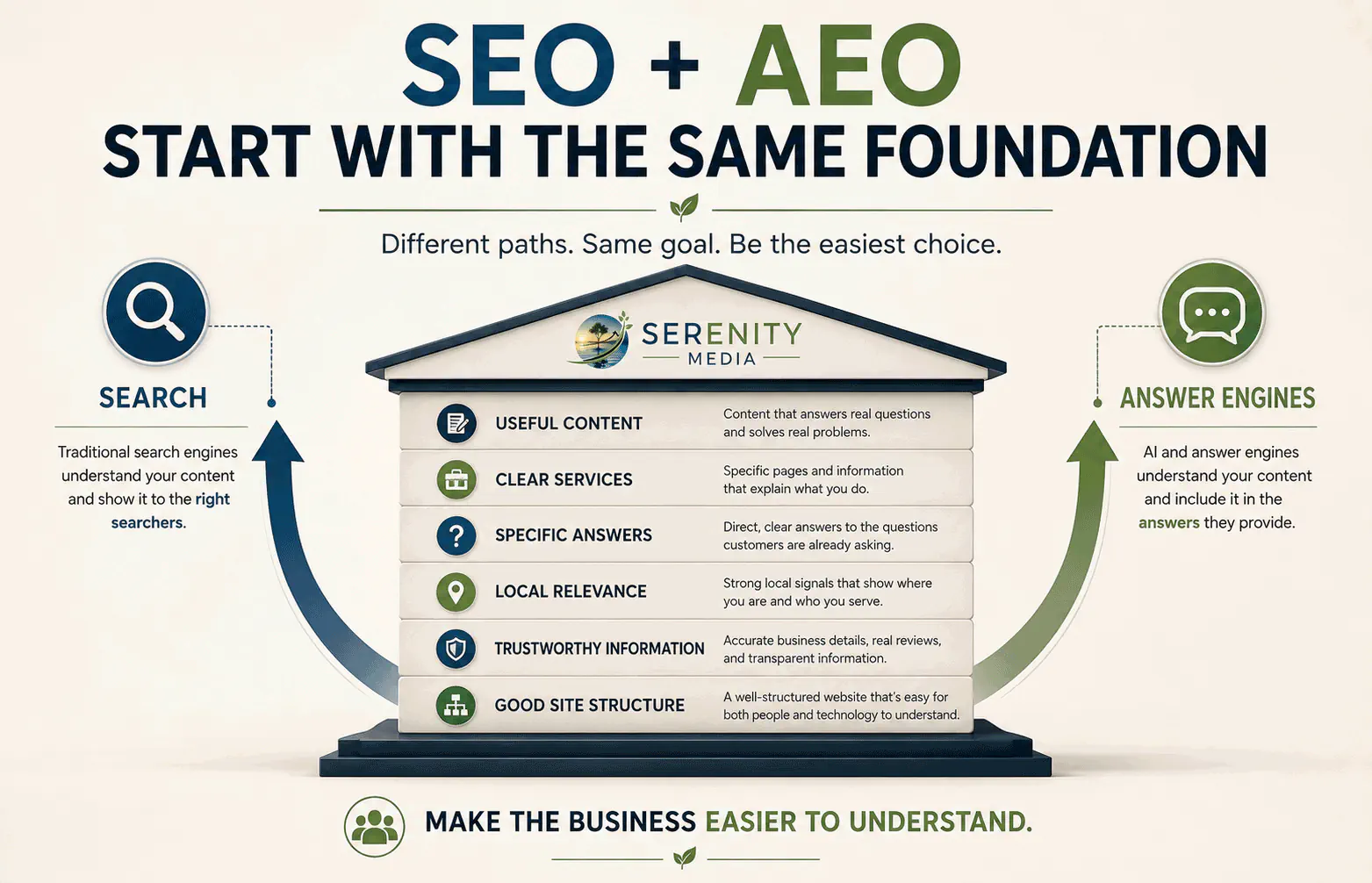
Strong SEO Still Needs
Clear page structure, useful service information, relevant content, internal links, local relevance, trustworthy business information, and pages that answer what people are actually searching for.
Strong AEO Still Needs
Clear answers, understandable page structure, specific facts, useful context, strong topical relationships, consistent business information, and content that can be interpreted without guessing.
There is a lot of overlap because both begin with making your business and its information easier to understand.
The goal is not to abandon Google optimization and start writing pages for robots. The goal is to build information that works well for people first and can also be clearly interpreted by search and answer systems.
More Content Isn't Automatically Better Content
One of the easiest ways for a small-business website to become bloated is to keep publishing new pages that answer questions the site already answers somewhere else.
Before writing another article, ask what the website already covers.
Then look for the question that is still unanswered.
That might be the difference between two services, what happens before an installation, how to know when something needs replacement, what an existing customer should do next, or how to decide between several options.
Useful content closes a knowledge gap. It should not exist only because someone said you need to publish four blog posts a month.
Every Piece of Traffic Needs Somewhere Useful to Go
Ranking is not the same thing as generating a lead.
A business can increase traffic and still make less money if the website becomes harder to navigate, the offer is unclear, the form is frustrating, or the visitor cannot figure out what to do next.
That is why traffic strategy and conversion strategy should not be separated from each other.
You Don't Need to Chase Every New Marketing Trend
Small-business owners already have enough to keep up with.
You do not need to rebuild your marketing strategy every time a new platform, AI tool, social network, or search feature appears.
You need a strong digital foundation that can survive those changes.
That means making it easy for people, search engines, maps, social platforms, and emerging answer tools to understand the same basic things:
Who are you? What do you do? Where do you do it? Why should someone trust you? What should they do next?
If your website, local presence, content, and conversion paths answer those questions consistently, you are in a much better position no matter where the customer's first interaction happens.
Build the Foundation Before Chasing the Next Trend
Serenity Media helps small businesses improve the pieces that work together: websites, SEO, AEO, local visibility, content, conversion paths, branding, and digital strategy.
The goal isn't more marketing for the sake of more marketing. It's a digital presence that helps the right people find your business, understand it, trust it, and take the next step.